
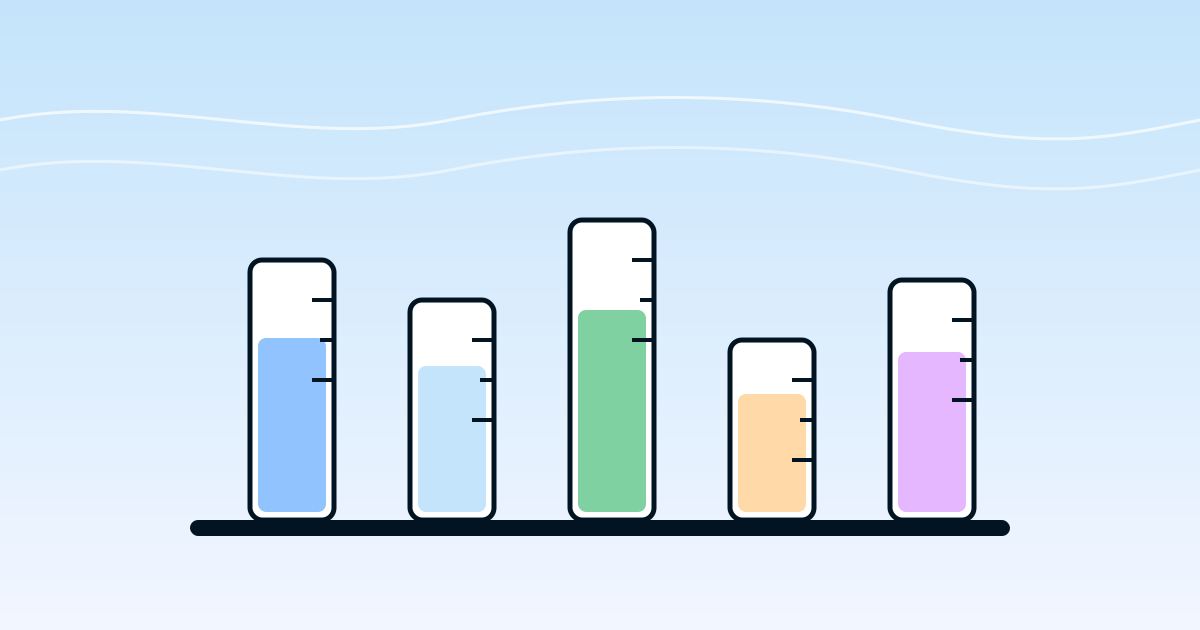
Most pool problems start with a number that drifted out of range. Cloudy water, itchy eyes, scale on the tile and algae are all symptoms. The chart below shows the targets, and the sections after it show how to correct each one without making a second problem.
For reference, the CDC recommends a pH of 7.2 to 7.8 and at least 1 ppm (part per million) of free chlorine in pools. The other ranges are the ones pool pros use most often. Your pool type, local rules and product labels come first.
The chart
| Measurement | Common target | If it is low | If it is high |
|---|---|---|---|
| Free chlorine | 1 to 3 ppm (never below 1) | Add chlorine; check stabilizer | Wait for it to drop, or dilute with fresh water |
| pH | 7.2 to 7.8 (many pros aim for 7.4 to 7.6) | Add pH increaser | Add pH reducer |
| Total alkalinity | 80 to 120 ppm | Add alkalinity increaser | Add acid slowly and aerate |
| Calcium hardness | 200 to 400 ppm for plaster; lower for vinyl and fiberglass | Add calcium increaser | Replace part of the water |
| Cyanuric acid (stabilizer) | 30 to 50 ppm | Add stabilizer | Replace part of the water |
Pro tip: Calcium hardness targets depend on the surface. Plaster and concrete pools need enough calcium in the water so it does not pull calcium out of the finish. Ask your pool builder or provider for the range that fits your pool.
How to read the chart
Free chlorine is the sanitizer that is still active. “Total chlorine” also counts chlorine already used up, so always test free chlorine. The CDC’s floor is 1 ppm.
pH tells you how acidic the water is. Low pH corrodes metal and irritates skin. High pH makes chlorine less effective and leaves scale. It is the number that moves most, so check it most often.
Total alkalinity acts as a buffer that keeps pH from swinging. Fix it first.
Calcium hardness is dissolved calcium. Too little can etch plaster. Too much leaves white, crusty scale on tile and inside the heater. If your tap water is hard, the pool starts out high and climbs as water evaporates, because evaporation leaves the minerals behind.
Cyanuric acid (CYA, stabilizer) shields chlorine from sunlight. Without any, outdoor chlorine disappears fast. Too much weakens the chlorine you do have, and the only fix is partial draining and refilling.
Test and adjust in the right order
Changing one number moves the others, so go in this order:
- Total alkalinity.
- pH.
- Sanitizer (free chlorine).
- Calcium hardness and stabilizer, checked monthly.
Wait a few hours between adjustments and run the pump so chemicals mix. Retest before you add more.
How often to test
- Free chlorine and pH: at least once a week in swim season, and more often in heat or after heavy use or storms.
- Alkalinity: every week or two.
- Calcium hardness and stabilizer: monthly, or when the water looks off.
A liquid drop kit is more precise than strips. Strips are fine for a quick check.
Find your pool volume before you add anything
Product labels give doses per 10,000 gallons, so you need your volume. For a rectangular pool:
length (ft) x width (ft) x average depth (ft) x 7.5 = gallons
A pool 30 feet long, 15 feet wide with an average depth of 5 feet holds about 16,900 gallons. Oval and irregular pools use different formulas, so ask your builder or use the volume printed in your paperwork.
Common problems and what causes them
- Cloudy water. Usually filtration or sanitizer. Clean the filter, then test chlorine and pH.
- Green water. Algae. Follow our guide to cleaning a green pool.
- Scale on tile or in the heater. High calcium or high pH.
- Eye and skin irritation. Often a pH problem, or chlorine that has bonded with sweat and oils. It rarely means “too much chlorine.”
- Chlorine disappears in a day. Low stabilizer, or a lot of sun and heat. Hot climates make this worse.
- Chlorine reads fine but the pool grows algae. Check stabilizer. Very high CYA can make chlorine sluggish.
Handle chemicals safely
This part is not optional. The CDC reported nearly 5,000 emergency room visits for pool chemical injuries in 2012, and nearly half involved children and teenagers. Follow these rules:
- Never mix different chemicals, especially chlorine products with acid.
- Add chemicals to water, not water to chemicals, and follow the label.
- Store acid and chlorine apart, dry, cool and closed in their original containers.
- Keep everything where children and pets cannot reach it.
When it is easier to hand it off
Balancing water takes a few minutes a week once you have the routine, but it takes patience at first. If you would rather not do it, a weekly pool cleaning service tests and adjusts the water on each visit. You can compare independent providers and decide what fits your pool.
For a schedule you can follow, read how often to clean your pool. If the water has already turned, start with the green pool guide.
Sources
- Check out healthy and safe swimming (CDC)
CDC recommends pH 7.2 to 7.8 and free chlorine of at least 1 ppm in pools.
- Operating and managing public pools, hot tubs and splash pads (CDC)
CDC guidance for public pools: keep free chlorine at 1 ppm or higher and pH between 7.0 and 7.8.
- Thousands sent to emergency room by preventable pool chemical injuries (CDC press release, 2014)
Pool chemicals led to nearly 5,000 emergency room visits in 2012. Nearly half involved children and teenagers, and more than a third happened at a home.
- Pool chemical safety: storing pool chemicals safely (CDC)
Keep incompatible chemicals apart, such as acid and chlorine. Store them dry, cool, closed and in their original labeled containers.
Want a pro to handle it?
Describe your pool once and independent local providers reply with quotes. It is free and you are not obligated to hire anyone.
Keep reading
Do It Yourself Pool Cleaning vs. Hiring a Pool Service
Do it yourself pool cleaning or hire a pool service? Compare costs, time, risks and skills, and see when a hybrid approach makes sense.
How Often to Clean a Pool: A Practical Weekly Schedule
How often to clean a pool? Follow this weekly schedule for skimming, brushing, testing and filter care, and adjust it for heat, rain and trees.